
I was thinking about the emergence of intelligence the other day and ended up going deeper than I expected. So I thought I'd try to write it out.
It started with a simple question. Why did humans evolve to be this intelligent compared to other species? We can do calculus, build computers, send things into space. What was the evolutionary need for that big a gap between us and other species on the planet? Nothing in our prehistoric evolutionary environment required us to solve differential equations.
I got into a deep discussion with Claude on this topic and came to the conclusion that we didn't evolve for calculus. We evolved a set of general purpose cognitive tools to navigate complex social groups and figure out how to hunt, gather, and survive. Those tools turned out to be powerful enough to also do math and science. The complex math and science was a side effect. In short, calculus wasn't the goal, it was a bonus feature of a brain built for something else.
That sounded plausible, but it raised another question.
Chimps live in large groups (called troops for primates) and they do have a need to track alliances. Crows use tools and remember faces. I read that whales have culture and dialects. Dolphins are clever and octopuses are almost alien in their intelligence. So the raw ingredients, namely social complexity, tool use, communication or problem solving aren't unique to humans. So why did we end up building cities and rockets and they didn't?
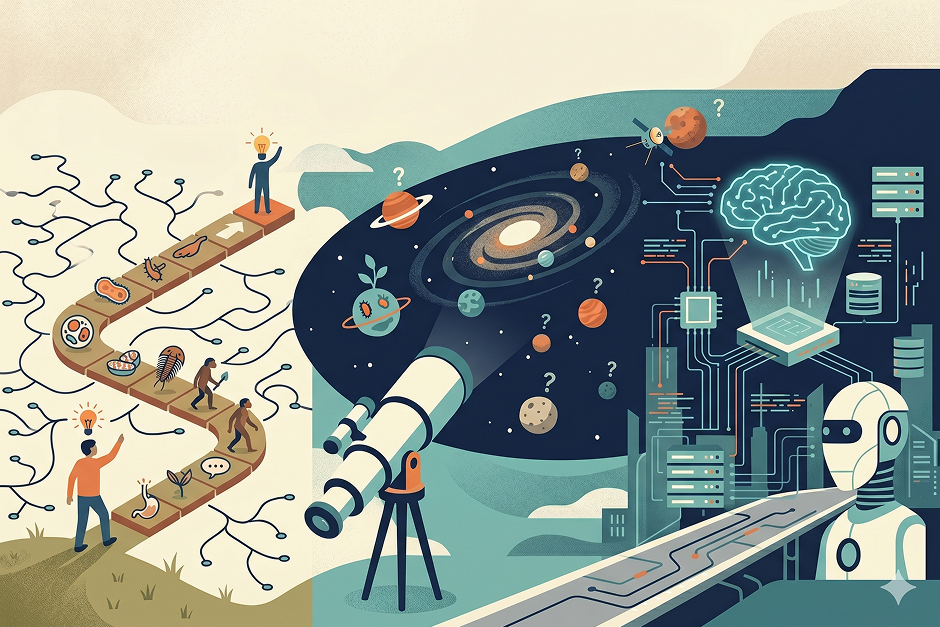
The best explanation I came across was that we hit a specific sequence of things, in the right order, and each step unlocked the next. Bipedalism freed our hands. Free hands made tool use easier. Tool use rewarded bigger brains. Fire and cooking unlocked enough calories to fuel our bigger brains. Our vocal anatomy enabled a range of sounds that supported language. Language allowed knowledge to accumulate across generations. And cumulative knowledge created pressure for even bigger brains.
"Calculus wasn't the goal, it was a bonus feature of a brain built for something else."
Meanwhile, chimps have smart hands but no fire and no language comparable to ours. Crows have clever problem solving skills but no manipulatable limbs. Dolphins have social intelligence but no way to build anything. Each species got a part of the capabilities and we just happened to get it all (mostly).
This is where I got stuck for a while.
What I learned and continue to believe (until I learn otherwise) is that each step made sense given the pressures on our species at each prehistoric period. Bipedalism was useful on the savanna. Tool use was useful for hunting and cooking was useful for extracting more energy from food. None of it was random — each adaptation helped us cope with the environment and its pressures.
But the fact that all these things lined up for our species in the right order wasn't inevitable. Each prior adaptation opened up the opportunity for something new to emerge. If the African climate hadn't shifted the way it did, the chain may never have started. If our ancestors had stayed in dense forests, bipedalism might not have been selected for.
So it was a combination of chance and necessity. Each adaptation had clear objectives but the sequence could have easily gone another way.
If you lay out all the conditions needed for human level intelligence, the list gets long fast. You need a planet in the habitable zone with liquid water on its surface. You need a stable star and probably a large moon to keep the climate steady. Probably a Jupiter-sized planet nearby to block asteroids and so on. Then there is the origin of life itself, which we still don't really understand. The jump from simple cells to complex cells, which took about two billion years and might have only happened once (maybe?). Then multicellular organisms, then nervous systems, all tied together in a specific evolutionary sequence.
This long drawn funnel of circumstances and evolution means that intelligent life might actually be genuinely rare. Not impossible anywhere else, but rare enough that we might most likely be alone in our corner of the universe. But we can't be sure about this. We are a sample size of one, which is a weak foundation for any conclusion. Maybe there are paths to intelligence we can't fathom because we're anchored to our own story. But if I had to bet, I'd bet that complex intelligent life is uncommon.
Does intelligence need life at all?
Until very recently (I'd say 2022, when attention-is-all-you-need made it out as a product), the answer seemed to be an obvious yes. Intelligence, as far as we knew, required brains. Brains required biology and biology required billions of years of evolution. Biological life was the prerequisite.
But we just built intelligence out of silicon. No cells, no DNA, no metabolism, and not alive by any biological definition. So the answer appears to be: no, you don't need biological life to create intelligence, silicon can do it too. But what we don't know is whether intelligence can arise from something that was never alive. Could some non-living system — a complex chemical process, a physical pattern, or something we haven't imagined — produce intelligence on its own, without biology anywhere in the chain? We don't know. We've never seen it happen. But we've been around for just a blink on the scale of our planet's evolution, using tools built by biological minds to find things our biological minds would understand.
None of this is settled in my head. But here's where I am right now.
Intelligence at our level is probably the result of a long chain of things that didn't have to happen, but did. Each step made sense in its moment. The full sequence wasn't inevitable. Other species got parts of the chain of adaptation, but we got the right parts in the right sequence, and once we got it, we ran with it.
And now we're building intelligence outside biology entirely. Which means the process that produced us might not need us to continue. I don't know if that's exciting or unsettling. Probably both.